


Every morning, as sunlight slips through our window, we rarely stop to ask a simple question: How old is this light?
Most of us would instinctively answer, “About eight minutes.” After all, light from the Sun takes roughly eight minutes and twenty seconds to reach Earth. While that is true, it tells only the final chapter of a much longer and far more extraordinary story.
The light warming your face today may have begun its journey thousands, perhaps even hundreds of thousands, of years ago.
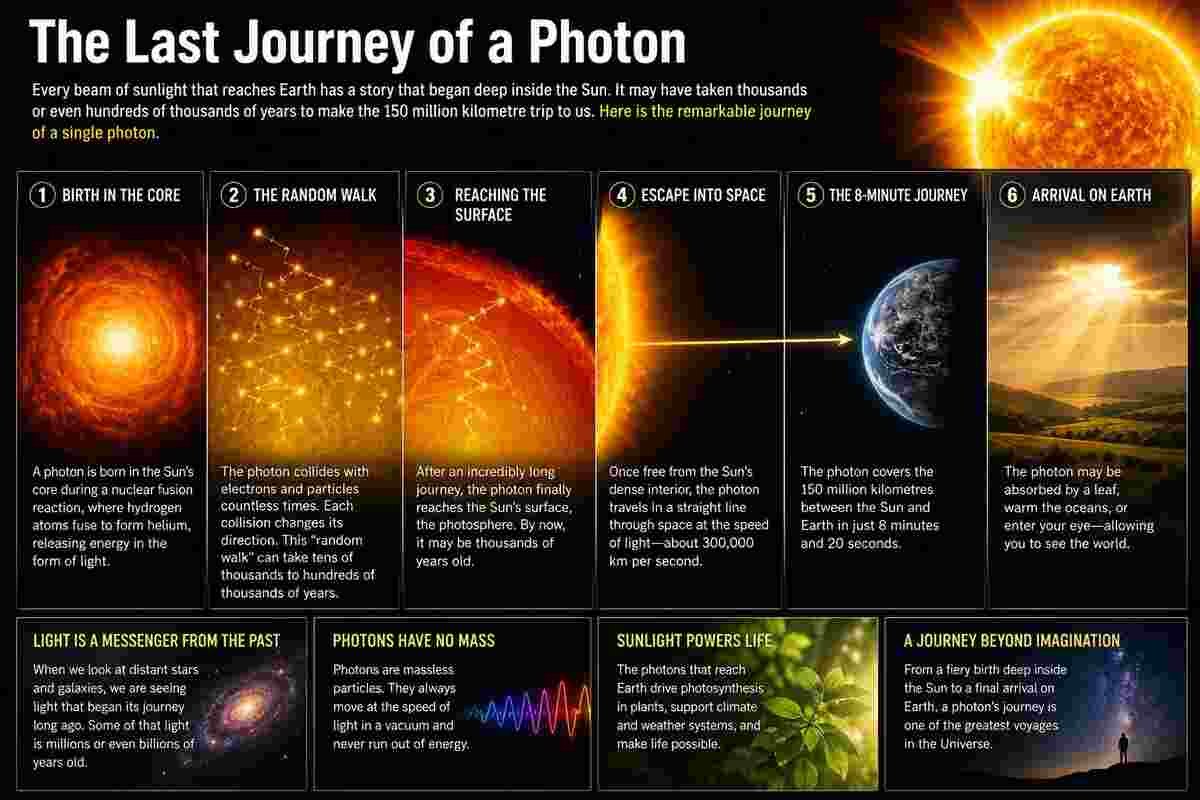
At the heart of the Sun, where temperatures exceed 15 million degrees Celsius, hydrogen atoms continuously fuse into helium. This process, known as nuclear fusion, releases an enormous amount of energy. That energy is born in the form of tiny packets of light called photons.
If the Sun were empty, a photon would leave its core and reach Earth in just over eight minutes. But the Sun is anything but empty.
Its interior is unimaginably dense. A newly created photon cannot travel in a straight line. Almost immediately it collides with charged particles, is absorbed, re-emitted and scattered in a completely different direction. A moment later, the same thing happens again. And again.
This endless sequence continues countless trillions of times.
Scientists often describe this as a “random walk.” Imagine trying to leave a crowded stadium where every person pushes you in a different direction after every single step. Although the exit may be only a short distance away, escaping could take an extraordinarily long time.
The same happens inside the Sun.
A photon may move only a tiny fraction of a millimetre before another collision changes its path. Over time, these countless detours mean that a journey of only about 700,000 kilometres, the distance from the Sun’s centre to its surface, may require tens of thousands or even hundreds of thousands of years.
Only after finally reaching the Sun’s visible surface, the photosphere, does the photon begin the easiest part of its existence.
Now there is almost nothing left to stop it.
Travelling through the near-vacuum of space at approximately 300,000 kilometres per second, it covers the 150 million kilometres between the Sun and Earth in just eight minutes and twenty seconds.
Some of those photons strike oceans and warm the water. Some are absorbed by leaves, powering photosynthesis that produces the oxygen we breathe and the food we eat. Others bounce off mountains, clouds and buildings before entering our eyes, allowing us to see the world around us.
In a sense, every sunrise is the arrival of countless ancient travellers.
The story becomes even more remarkable when we look beyond our Solar System.
The light from the nearest star after the Sun, Proxima Centauri, needs more than four years to reach us. When astronomers observe the Andromeda Galaxy, they are seeing light that began its journey about 2.5 million years ago, long before modern humans built cities or developed written language.
Astronomy is therefore unlike any other science.
A geologist studies rocks that exist today. A biologist observes living organisms in the present. But an astronomer is always looking into the past. Every telescope is, in a very real sense, a time machine.
The stars we admire tonight are not showing us how they look now. They are revealing how they looked when the light first left them. Some may already have changed dramatically. A few might even have disappeared, while their last photons continue their silent journey across space.
This idea changes the way we think about the night sky.
What appears to be a peaceful moment of stargazing is actually an encounter with history. Every beam of light carries information about the place where it was born. Hidden within that light are clues about temperature, chemical composition, motion and even the age of distant stars and galaxies. By studying these faint signals, physicists have reconstructed much of the history of the Universe.
Perhaps the greatest lesson from a photon’s journey is philosophical rather than scientific.
The sunlight touching our skin today is the final destination of a voyage that may have begun long before human civilisation took its earliest steps. It reminds us that nature operates on timescales far beyond our daily lives. While we measure our existence in years or decades, the Universe patiently measures time in millions and billions of years.
The next time sunlight falls across your desk or you pause to admire a sunset, remember that the light before your eyes is not simply eight minutes old. It is the survivor of an unimaginably long journey, born in the fiery heart of a star, wandering for ages through the Sun itself before racing across space to reach a tiny blue planet where, for a brief moment, someone chose to look up.
That may be the most remarkable journey ever completed without taking a single step.
Milan Karmakar
Asansol Paschim Bardhaman West Bengal
Mail: milankarmakar45@gmail.com
Mobile:9564191298