

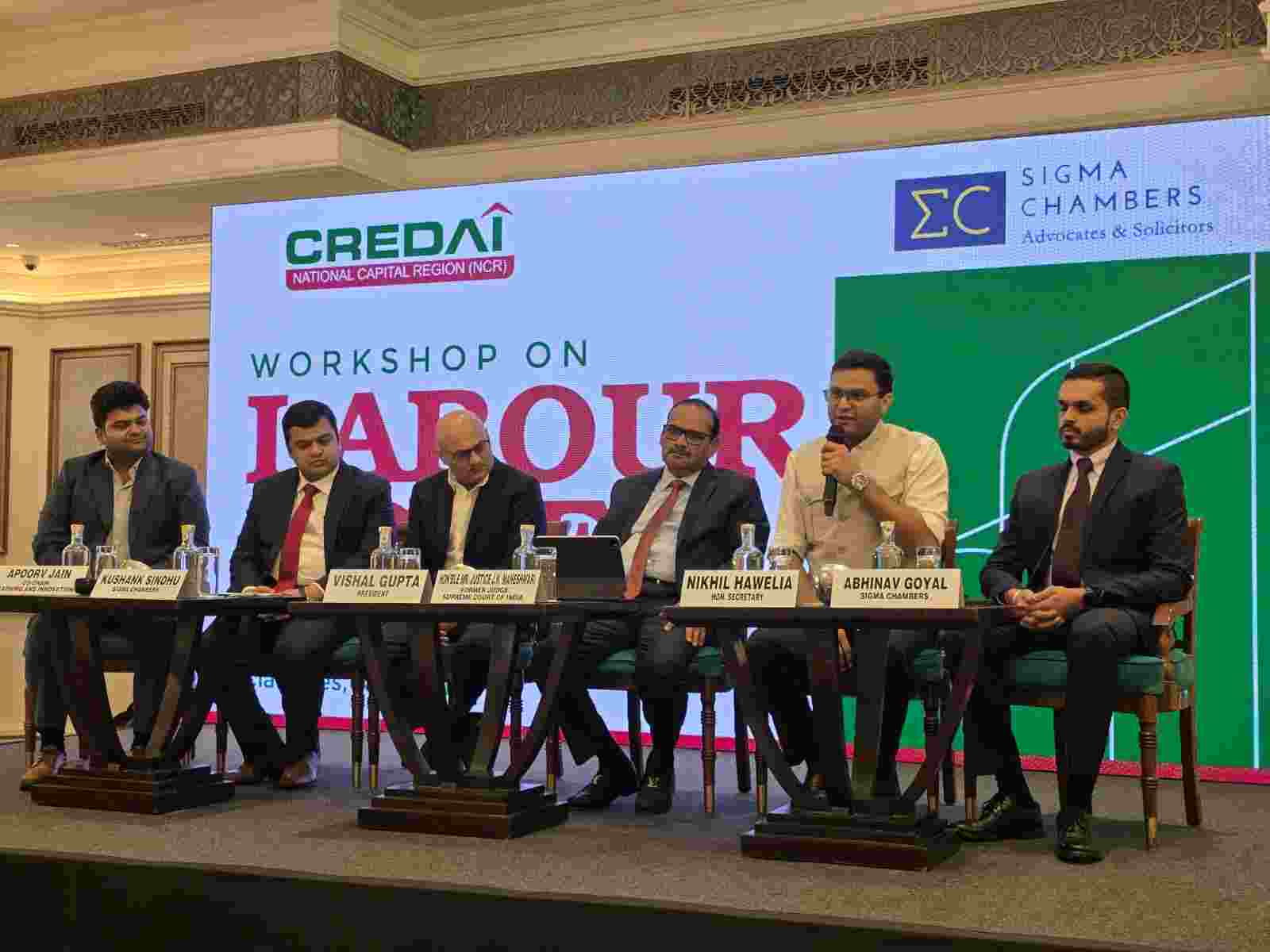
Hon’ble Justice J.K. Maheshwari, retired Judge of the Supreme Court of India, sets the context for an interactive session on the New Labour Codes.
New Delhi: In a major knowledge-building initiative for the real estate sector, CREDAI NCR organised an intensive, interactive workshop on the New Labour Codes .The significant event successfully brought together more than 100 real estate developers from across the National Capital Region to analyse and examine the practical implications of evolving labour legislation for the construction industry. Hon’ble Justice J.K. Maheshwari, a retired Judge of the Supreme Court of India, addressed the participants and set the context for the session. The session was moderated by Apoorv Jain, Director, One Group Developers; Abhinav Goyal, Partner, Sigma Chambers; and Kushank Sindhu, Partner, Sigma Chambers. By emphasising real-world construction scenarios and practical questions, the specialised program was meticulously designed to assist regional developers in better understanding their statutory responsibilities while strengthening overall compliance practices across their corporate offices, projects, and contractor networks.
The comprehensive workshop moved well beyond a conventional legal briefing, as CREDAI NCR partnered with Sigma Chambers as its dedicated knowledge partner. Together, they examined the intricate, day-to-day operational questions that developers frequently face. The core discussions actively covered the entirety of the four New Labour Codes: the Code on Wages, the Industrial Relations Code, the Code on Social Security, and the Occupational Safety, Health and Working Conditions Code. A central, key feature of the program was the introduction of a structured questionnaire titled The New Labour Codes for Real Estate – 29 Questions, Answered. This targeted resource was specifically developed to directly address the practical and immediate compliance concerns relevant to developers, contractors, human resource teams, finance professionals, and on-site personnel.
During the interactive session, participants thoroughly examined several critical operational areas from both legal and practical standpoints. The developers focused heavily on wage calculations and statutory benefits, specifically analysing the definition of wages and its direct impact on provident fund, ESI, gratuity, bonuses, and other employment-related entitlements. Due to the complex nature of the construction sector, the workshop dedicated significant time to contract labour and employer responsibilities. Attendees evaluated the respective obligations of developers, EPC contractors, subcontractors, and labour suppliers regarding wage payments, statutory contributions, and worker welfare. Furthermore, the session explored building-worker welfare and migrant labour responsibilities, emphasising safe working conditions, welfare facilities, precise worker records, and statutory protections.
The legal and operational discussion extended to construction cess and Building and Other Construction Workers (BOCW) compliance. Participants discussed establishment and worker-related requirements, construction welfare cess, supporting records, and payment documentation. Occupational health and safety systems were highlighted as crucial elements, with a focus on site-level safety systems, accident reporting, welfare arrangements, and contractor monitoring. Additionally, the seminar addressed employment, grievances, and project completion, detailing fixed-term employment, separation, retrenchment, grievance mechanisms, and the documentation required when employment arrangements change. Finally, the workshop identified practical checks and compliance records that help developers monitor ongoing compliance and respond appropriately to inspections or worker complaints.
Commenting on the initiative, Shri Vishal Gupta, President of CREDAI NCR, emphasised that compliance is the foundation for responsible growth. He stated that the New Labour Codes are an important subject because their implementation touches every level of real estate operations, from corporate offices to contractors and construction sites. He noted that responsible growth must go hand in hand with legal compliance, worker welfare, and high standards of professional conduct. He affirmed that the workshop was designed to help members move beyond simple awareness of the law toward a clearer understanding of how to implement it in practice, adding that an informed industry is better equipped to protect workers, manage risk, and build with greater confidence and accountability.
Shri Nikhil Hawelia, Secretary of CREDAI NCR, also shared his perspective on the value of the event, stating that the real worth of a workshop lies in whether participants can take the learning back to their organisations and apply it. He explained that by bringing legal expertise and practical industry questions into one focused forum, CREDAI NCR sought to address the exact challenges developers encounter in dealing with wages, contractor compliance, social security, and site responsibilities. He noted that the participation of more than 100 developers reflects the immense importance the industry attaches to this subject, and he pledged that CREDAI NCR will continue to create platforms that turn complex regulatory requirements into actionable knowledge for its members.
The successful event ultimately demonstrated strong industry interest across the NCR in understanding the practicalities of the legislative shift. Because real estate operates through extensive contractor networks and large, geographically dispersed workforces, these structured knowledge-sharing initiatives play an important role in improving awareness, strengthening internal processes, and promoting responsible employment practices. Through this workshop, CREDAI NCR reaffirmed its commitment to supporting its members through relevant learning programmes, expert engagement, and practical guidance on regulatory developments, contributing to a more informed, accountable, and professionally equipped real estate industry that recognises compliance as an essential element of sustainable development.